
At a Glance
Objective
This resource builds classroom community and helps students (and the teacher) learn names quickly through a low-stakes, mingling-based activity. It gives students an icebreaker that references what they're actually into — anime, gaming, true-crime podcasts, building PCs, small-creator merch — instead of content written for a much younger audience. Provide a reusable classroom-community tool, not just a first-day-only activity.
- Topics Covered
- back-to-schoolcommunityicebreaker
- Subjects
- All SubjectsClassroom Community
- Related Courses
- All Courses
- Type of Lesson
- activityicebreaker
Lesson Plan Notes Back to School Bingo Icebreaker
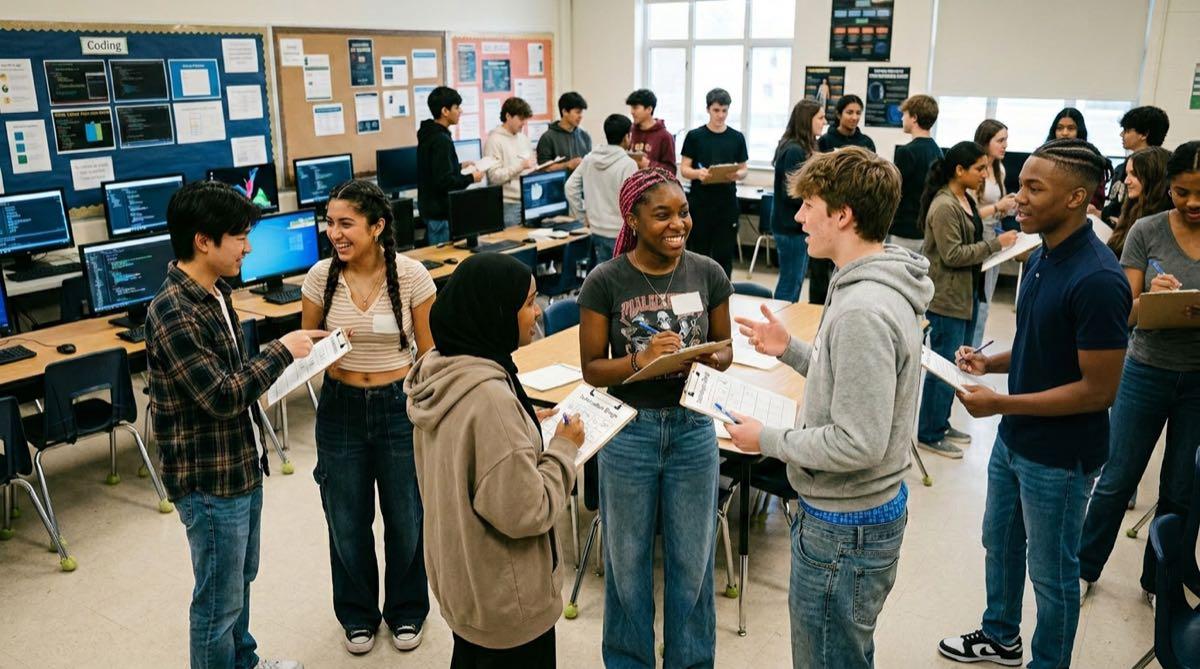
In my class, back-to-school bingo always happened in the first week of school. Usually, on the first day of school. It’s a great icebreaker that gets students moving around the room and allows you to observe their interactions. Without announcing it, you’re priming them for lessons on teamwork and employability skills that frame the content for the rest of the school year. In many workplaces, teams are encouraged to break the ice with a game before diving into job-related norms and expectations. As a manager, an icebreaker to the question of the day was often how we started meetings or introduced new hires to the team before getting into the nitty-gritty of their roles and responsibilities. So, back-to-school bingo is not a waste of time; it is a critical way to read the room and get to know your class as they get to know each other.
Social Emotional Learning
It can be nerve-wracking to approach a stranger to talk, and in high school, there can even be all kinds of social barriers to chatting with people you know. A teacher-directed game like this aims to throw all that out the window. The directions are to talk with as many people as possible. Not to hand your list over and have the other person silently read and circle the descriptions that pertain to them. Some students will definitely try that! Let them know that in your class, there will be a lot of group work and teamwork, so it’s important to practice those skills.
High School Emphasis
These questions are not the elementary school variety. Some are more general, like “Went on a road trip this summer”. But several are tailored to a high school audience. “Finished an anime series in one weekend”. These trivial yet more specific questions can help students make real connections based on genuine interests they are likely to have at the high school level.
Teacher Modeling Behaviors for Students
As a high school teacher, you can easily have 150 students to keep up with and remember! It’s always easier to remember someone when you have a memory with them. Back-to-school bingo helps you make those memories quickly and in a non-intrusive way. As different students report Bingo, the verification is peer-driven, not teacher-adjudicated — the winner reads their 5 names aloud, and each named classmate confirms the square is true. No teacher has to police 30 boards at once. But this doesn’t mean you can’t have a little fun with it. You can help cross-reference by confirming with the students. It might sound something like this:
Student: “I got Bingo!”
Teacher: “OK, great, call them out and let’s have a look at your sheet.”
Student: “OK, Maria has over 3 cats”
Teacher: “Where’s Maria? Hey Maria, how many cats do you have?”
Maria: “Four”
Teacher: “Nice, what are their names?”
Student: “Heathcliff, Tabby, Milly, and Rex”
Teacher: “OK, that one checks out. Thanks. Nice to meet you, Maria!”
This would continue until all the Bingo squares on that student’s board are verified. Meanwhile, you are modeling how to build relationships with your students as they do the same. They also get a chance to learn your personality! Encourage your students to continue circulating. Show them how to introduce themselves, then follow up with the question on their board. “Hey, I’m Mike. What’s your name? Do you play Fortnite?”
Teacher Strategies & Modification
In a class of 30, it might take 5-10 minutes before the first BINGO; about half the class has one by 15 minutes in. Definitely have some fun-sized or bite-sized candies as treats for winners! Candy and snacks always seem to motivate high school students!
You can also modify the rules for getting BINGO as a variation. For instance, Blackout, Four Corners + Center, Letter X, and Double Bingo are all different formations that could work. This means this isn’t a one-and-done first-day activity — it can flex from a 5-minute warm-up to a full period and get reused later in the year.
Remember, there are 35 unique boards in the full set, so no two students will have the same board, and there is no chance of two students getting exactly the same bingo. That, and the reliance on mingling, really keep the game interesting and randomized. By the end of the game, you will have a classroom-community snapshot you can reference all semester because signed boards become a record of who knows what about whom and a record for yourself to reference about students!